1. The Gloucester Wassail Song / Waverly Consort 4:13 2. I Saw Three Ships / Sufjan Stevens 2:34 3. Beautiful Star of Bethlehem / Ralph Stanley & the Clinch Mountain Boys 3:52 4. God Rest Ye Merry Gentlemen / Jimmy Smith 4:19 5. Navidad / Gipsy Kings 3:25 6. Come Ye / Nina Simone 3:39 7. O Little Town of Bethlehem / Sister Rosetta Tharpe 2:26 8. The First Noel / Cyrus Chestnut 3:28 9. Jingle Bells / Duke Ellington & His Orchestra 2:57 10. Lo! How a Rose E’er Blooming / Sufjan Stevens 3:22 11. Il Est Né Le Divin Enfant / Trapp Family 1:18 12. Hoy Es Dia de Placer / San Antonio Vocal Arts Ensemble 2:02 13. Noite Feliz / Palavra Cantada 2:23 14. Sleigh Ride / Ella Fitzgerald 2:58 15. Come On Christmas, Christmas Come On / Ringo Starr 3:35 16. Jesus Ahatonnia (The Huron Carol) / Bruce Cockburn 6:31 17. Riu, Riu, Chiu / Benjamin Bayl & Choir Of King's College, Cambridge 2:09 18. That Was the Worst Christmas Ever! / Sufjan Stevens 3:18 19. Go Tell It On the Mountain / Smokey Robinsoinson & The Miracles 3:46 20. Weinachten Im Moomintal / Dakota Oak 4:05 21. Children Go Where I Send Thee / Joan Osborne 4:23
* Two-thirds of the inspiration for this list comes from KCRW's wonderful annual three-hour Christmas/Gospel Music extravaganza, Morning Becomes Glorious, deliciously DJ'd by Andrea Leonard (I listen to the streaming archives year-round here: 2006, 2005, 2004, 2003). Actually, MBG's playlists only maybe 20 percent holiday music; the rest is just good, very wide-ranging Gospel tunes — in fact, the Christmas songs are generally not the ones I love the most.
Thus, it felt sort of silly to be compiling a Christmas mix, till I realized that, hey wait, I do really love plenty of Christmas music. Really it's just a certain sort of sentimental, shopping-mall-type song that I don't care for (ah, but even exceptions there — Bing Crosbey's expertly-crooned "Silver Bells" nearly made the list). But most of the above is very traditional/choral (I sang the Gloucestershire Wassail with my high school choir at dozens of Christmas gigs), very Gospel, much more the Christmas Story than Christmas stories.
Of course, it wouldn't be a Wimbo Zuri mix without songs in lots of languages, from lots of eras. I think I've come out pretty well on that account.
** What's Wimbo Zuri, you ask? Well, aside from simply the name of my mix-cd-producing fake record label, it's not-quite-correct Swahili for "good song". And just fun to say.
I'm fascinated by this bank ad that ran on the front page of DNA India: First, the suggestion that comfy retirement offers the chance to finally play the violin—a worthy goal, though I wonder how often arthritis might get in the way. But what really struck me was the non-Stradivarius-copy features of the fiddle: the slightly larger f-holes, and, above all, the fact that there's only one string! Was this just an error on the part of the props department, or a subcontinental adaption? A few quick searches turned up references to a one-stringed Indian viol called a riti, so perhaps it's that. Though I think in India classical music, the violin tends to be held in a pretty different posture. So who knows? Maybe you!
In any case, I was reminded of the 19th-century Italian virtuoso Niccolò Paganini:
In performance Paganini enjoyed playing tricks, like tuning one of his strings a semitone high, or playing the majority of a piece on one string after breaking the other three.
Prelude: Nine years ago when I was editing travel guides, it was a matter of pride for the musically-inclined editors to blast the office with guidebook-appropriate (or hilariously-innappropriate) music. For me, of course, that was arranged with a perpetual connection to a Bollywood-themed internet radio station. Over in the "domestic" room, the editors played Frank Zappa, Jonathan Richman, and, when a great laugh was needed, the following song, by French pop master Serge Gainsbourg:
[N.B. This embed, and for that matter the others, doesn't seem to work ... you can get the same effect by going to www.deezer.com and searching for "Serge New York". I'll work on the odeo players soon, I hope]
OK, forget all that for now. What I really want to write about is a story I heard whilst listening to one of the many excellent W.E.B. Du Bois Institute lectures they got online somewheres, specifically a series by (then) NYU prof Robin D.G. Kelley on Jazz and Modern Africa:
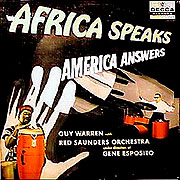
In this particular lecture he was talking about the specific mid-twentieth-century debate over who was and wasn't an "authentic" African drummer during the early cross pollinations between American jazz and music from contemporary Africa (the music itself, of course, having elements traditional and contemporary). Kelley's lecture is a lot about Guy Warren, who came from Ghana to the states in the early(?) 1950s with the goal of introducing the talking drum to American jazz. His first records wound up coming out around the same time, more or less, that a few African-American jazz drummers (Art Blakey, and later I think Max Roach) were starting to use explicitly African titles and themes in their records. Basically Warren thought Blakey et al's music wasn't African at all, and was for that matter completely uninteresting.
Side note no. 1: Guy Warren's first album, "Africa Speaks, America Answers" was recorded with the Chicago band he'd been playing with -- a band, which was, with the exception of Warren and an African-American drummer, composed entirely of Jews and Italians (who nonetheless did all right with the call and response stuff). Prof. Kelley also noted, as something of an aside, that although several influential African-American jazz musicians were drawn particularly to what they saw as the authentic African spirituality of Warren's music, Warren himself was neither Muslim nor Christian nor Animist but in fact a practicing Buddhist. Anyway, Kelley says his music was, perhaps not so surprisingly, ambitious and drew on a ton of different traditions: African, Jazz, classical, etc. This probably made him less than an ideal candidate for the role of "authentic African drummer".
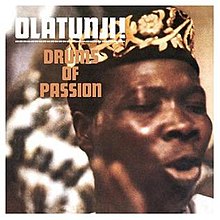
Enter Babatunde Olatunji ... who came to the U.S. from Nigeria on a Rotary scholarship and attended Morehouse College and then NYU grad school, studying political science. To make extra money, he started playing music with an ensemble he'd put together — traditional West African stuff and original compositions, though Kelley notes that a lot of his training as a percussionist had apparently come from African American musicians he'd known since coming to the States.
Anyway, Olatunji was playing at Radio City and got "discovered" by a Columbia record exec who signed him and, a year or two later, got him into CBS studios in New York to record "Drums of Passion" — which not only went on to vastly outsell anything by Guy Warren or, I think, any of the other Africanist projects by American jazz musicians, and in fact has never gone out of print, and now gets cited, on various promo-type sites, as being possibly first real (successful) "world music" album, the first real studio-recorded album of real African music, etc. etc. etc.
Whether or not Olatunji was better qualified than Guy Warren to be known as the introducer, at least he turned his popularity into a long and very legitimate career both in the African American, jazz, and world music communities. A few years before he died in the 1990s he did some sort of collaboration with one of the Grateful Dead, though which one I cannot say.
Fascinating story, I thought (and hopefully you think). So I hopped on over to iTunes to see just what the original authentic drummer sounded like. I clicked on the first track of "Drums of Passion" and ... well, something seemed awfully familiar.
Just what was going on here? Who copying who? A few searches turned up lyrics and the story of the song in question—
Akiwowo (Chant to the Trainman)
This is the song about the legendary conductor when railroud trains were first introduced in Nigeria over five decades ago. Millions still remember Akiwowo, who always made sure that his passengers, mostly men and woman returning from their farms with their products balanced on their heads,never missed the train, as well as his warm welcom, broad smile and humor. Akiwowo, now in his eighties,lives happily in the village of Pa-Pa Lanto full of sweet unforgettable memories of his service to his people and country.
Akiwowo Oloko lle lowo Gbe Mi Dele Ile Baba Mi
Akiwowo conductor of the train Please take me home To my fathers house
As for how exactly "Akiwowo" became "New York USA" let us turn to the following computranslation from Serge Gainsbourg's French record company:
Serge enters in studio from the 5 to October 16, 1964, with Goraguer, for a second 30 cm, "Gainsbourg Percussions". Via Guy Béart, it impregnates disc "Drums of Passion" of the Native of Niger Babatunde Olatunji.
For "New York the USA", Serge is inspired — rate/rhythm, arrangements, melody, technical question and answer between the singer and choruses — by "Akiwoko (Song To The Trainman)". For "Over there it is natural", of a counterpoint of Myriam Makeba.
Many years later, when to the USA a disc leaves Serge containing "New York the USA", Olatunji brought in Gainsbourg a lawsuit for plagiarism.
It seems worth noting that whereas "New York USA" was presumably adapted/recorded in France, "Akiwowo" was recorded (and quite likely written) in New York. So without too much difficulty we might imagine Olatunji listening to the clatter of subway or el trains and thinking wistfully back to the famed Nigerian railway conductor. (Incidentally, the click-click-clack percussion makes perfect sense with the original song's rail theme).
But of course we are left to ponder what exactly led Serge to impregnate disc "Drums of Passion", and why concerning New York, and for that matter what became of that lawsuit for plagiarism brought in him by the first original real and authentic African drummer in USA.
Postlude: More media! Here's a much-older Babamayo Olatunji performing a Liberian rhythm:
... and here's, from France's Institut National de l'Audiovisuel, a prehistoric music video of Serge Gainsbourg's "New York USA" — the song begins after a 1min. introduction by the French chanteuse Barbara:
... and — because I could —here's a map of all the buildings Gainsbourg sings about (scroll down for the Bank of Manhattan at the island's tip):
A couple of weeks back I was watching a Chinese film, Quitting (Zuotian - 昨天 - trailer here), a really great semi-documentary about a young actor coming out of drug addection in 1990s Beijing. There's one scene where all the young cool folks are hanging out together, celebrating the protagonist's birthday, and they start singing a song to the tune of the old American gold-miner's lament, "Oh My Darling, Clementine".
I rewound the movie so I could type out the subtitles:
wish you longevity as long as a pine tree of the Southern Mountain may you have good fortune as much as the endless water in the Eastern Ocean
I emailed a bunch of Chinese-American friends to find out if they knew anything about this version of "Clementine" —and whether it was a specific "birthday song" used, perhaps, in place of the ubiquitous, but technically still copyright-protected "Happy Birthday To You"? But nobody'd heard aything about it.
Interestingly—getting back to copyright—The Beatles' music plays a significant role in the plot of Quitting, but makes no appearence on the soundtrack—it's all Chinese rock (which works quite well—even in the scenes where you're watching the main charactar listening to a Beatles album on his headphones ... actually, the whole film is accessible but also again and again visually, sonically, and conceptually arresting).
In any case, I wonder when the "Clementine" melody made it back to China ... obviously Chinese immigrants were an important of Gold Rush (and post-Gold Rush) California ... perhaps it made it back soon after it was written (in the 1880s, but based, perhaps on a song from the 1860s). Most likely it arrived much more recently. But I like the idea of a former Chinese "Miner '49er" making his way back to China in his old age (long as the pine on the Southern Mountain), bringing the song from Gold Mountain.
Though I've already posted on M.I.A., her second album, Kala, is out this week, complete with a wonderful Mobutu-print-inspired cover. She did a lovely live session at KCRW a couple weeks back — I was beside myself when she launched the first song, "Bamboo Banger" with a half-cover of Jonathan Richman's "Roadrunner" (though omitting the part about driving to the Stop-N-Shop). I also loved a line from her second song, "Hussel", that went more or less, "I put people on the map / who've never seen a map". And I can't tell whether her off-pitch singing is a sort of casual swagger or an homage to the semitonal wonders of South Asian (and particularly South South Asian) singing styles. Probably both.
Rounding out music news: Josh Ritter has a new album, e'en edgier than the last but sounding quite good from what I've heard. I'll have to get it sometime.
And two recent indie-rock discoveries: Vampire Weekend (think Paul Simon's Graceland with a punk-pop sensibility), and Bishop Allen (I heard their song "Castanets" on the KEXP podcast and thought, "wow, what a great song!"; then looked up the band name and thought, "wow, they're named after one of my favorite-named Cambridge, MA streets!", then looked at who was in it and thought, "wow, I used to work in the same office as the lead singer! we used to nod hello!").
A few weeks ago my father surprised me with a garage-sale gift: an old Oscar Schmidt Autoharp. Since then I've sporadically been figuring out how to play it ... the basics of which are more involved than I'd supposed. First, there's the matter of deciding how you want to hold and strum it. Here are some examples, with my own made-up titles for 'em:
A) The Mirror. I discovered this video during a fruitless attempt to find a recording of Jimmy Carter reading some of his poetry. The consolation prize, as you'll doubless agree, was more than worth it. Note the left-handed strumming, which is easiest given a tabletop-layout, but feels just wrong since I already play cello and guitar in the standard poses.
B) The Bridge-Strummer. Difficult on my particular harp, which has the maximum amount of buttons/keys, narrowing the target era quite a bit. Still, can't argue with June Carter Cash:
C) The Crossover. Just plain awkward:
D) The Upright Reverse Half-Piano Hug. This is the one I've settled on. Earl Scruggs and Mother Maybelle Cash.
I've been meaning to pass on this tidbit to music-loving friends for a while: It's a 1997 radio interview with Keith Richards (with Liza Richardson on KCRW), promoting his Rastafarian drum and chant project "Wingless Angels".
Commenting on reggae music's multiple roots, Keith notes that, back in the formative days, in Jamaica they could just recieve the high-power radio transmissions from two U.S. cities: Nashville and New Orleans. Keith posits that reggae fused those influences: the back-beat of New Orleans funk becoming the reggae off-beat rhythm (I'm sure I'm muddling the rhythmic terms here), and the melodic approach of country-western informing the singing.
Not being as knowledgable about things reggae as some, I'll leave it as a fascinating fable (maybe mostly true) of cross-cultural pollination.
I heard second second track yesterday on KCRW ... a preview of M.I.A.'s sophomore album, due out later on. As usual, the UK/Sri Lankan rapper (um, chanter?) is up to her in-your-face, low-resolution tricks. But musically I find it a lot more interesting than a lot of the stultifyingly repetitive dancehall-beat stuff I've heard (largely reggaetón but not exclusively) over the past few years. Beyond that, there's the M.I.A. aura, aggressively transcultural, sort of an anti-Peter-Gabriel. And the lyrics are, for a get-on-the-floor dance song, a tremendous celebration-cum-feminist-critique of rowdy masculinity and its geopolitical consequences.
One thing that comes up for me, perhaps irrelevantly, is the sticky authenticity question. On the one hand, as Sasha Frere-Jones's New Yorker review of her debut album put it, she's giving voice to the third-world street (and its first-world urban echoes), delivering music "from a place where kids throw rocks at tanks, where people pull down walls with their bare hands. It could be the sound of a carnival, or a riot". (it's a great line by Frere-Jones, but I don't know how much M.I.A. herself talks about trying to be or not to be anybody's version of an authentic voice).
But M.I.A.'s whole approach, from music to videos to her artwork and anti-fashion attire (like a can't-stop-looking-at-it 1980s nightmare, with giant Reebok logos spraypainted on in a sort of piracy of piracy itself), is extremely canny, intellectual, and in ways more first-worldly than third-. Which is what lifts it over the bar and onto KCRW or into the New Yorker, where someone like me hears it and likes it—or at least can't stop listening—and feels a bit more authentic, hip in the way that certain NGOs are hip, for doing so ("pull up tha PEE-ple, pull up the Poor").
In the dream I was driving. Down the road. In the car. And next to me ... was Ira Glass.
Not bad, I hope, for a first attempt at audio embedding (gracias a the Internet Archive and OdeoStudio). Well actually, second. The first attempt didn't record the voiceover at all. A third attempt might have done something about the audio levels, but that's enough going on for one day.
Also in hindsight the comments I make about television doubtless owe an arm and a leg to Rob Long's wonderful weekly Martini Shot commentaries on KCRW, most recently and specifically this one.
For the past few weeks I've been reading a collection of Martin Luther King, Jr.'s speeches, essays, sermons, books, and other writings. Obviously, plenty of inspring and moving stuff (what else did I expect?) — and also, given the nature of public speaking, a lot of repetition. It's a delight seeing phrases and pieces from the "I Have a Dream" speech popping up years ahead of time.
One thing that's surpised me is the extent to which MLK quotes from white intellectuals—James Russel Lowell, Ralph Waldo Emerson, Paul Tillich, Victor Hugo. I'm not sure if I can recall him quoting Frederick Douglass, W.E.B. DuBois, or Booker T. Washington. I wonder if this was because of philosophical differences with those African-American luminaries, or more that he consciously needed, in speaking to the majority culture, to win their trust by referencing majority figures?
I did have a kind of amusing surprise as I read the text of King's final, deeply prophetic "I've Been to the Mountaintop" speech—delivered the night before his assasination. I was familiar with the moving, slightly eerie climax, which is in the video clip above. But earlier on in the speech, he's sort of rambling along about the latest boycott the SCLC is supporting:
And so, as a result of this, we are asking you tonight, to go out and tell your neighbors not to buy Coca-Cola in Memphis. Go by and tell them not to buy Sealtest milk. Tell them not to buy—what is the other bread?—Wonder Bread. And what is the other bread company, Jesse? Tell them not to buy Hart's bread. As Jesse Jackson has said, up to now, only the garbage men have been feeling pain; now we must kind of redistribute the pain.
For me those two elements—Jesse Jackson and Wonder Bread were this strange, almost jarring intrusion of the present-day into an iconic American speech.
(I had a similar bit of cognitive dissonance when I first saw, last year, footage of Bob Dylan singing at the March on Washington. It was as if they'd taken the familar film of King's speech—those guys in the white hats standing behind, etc.—and Zelig'd the pop icon into the scene.)