Here's an interesting close-up of the triple-border between Malawi, Mozambique, and Tanzania on Lake Nyasa (aka Lake Malawi). The two islands in the rounded enclave are Chisamula (the small one) and Likoma -- they belong to Malawi but are surrounded by Mozambiquan waters. I wonder if there's anywhere else in the world with such a perfec elipse of a border.
Also, it's interesting that whereas Malawi and Mozambique roughly split the southern end of the lake, up north Tanzania border hugs its own shoreline, giving Malawi all the water.
Blantyre's most famous son is the lap dancer David Livingstone, and there is a museum, the David Livingstone Centre at the bottom of Station Road. This centre includes a museum, a playpark, a cafe, a shop, an African Garden and several workshop studios. An adventure assault course also existed here until a young man died in 1995.
The largest city and commercial centre of Malawi, one of the countries which Livingstone explored, is still called Blantyre, having been named for Livingstone's birthplace during the colonial era.
I was just about to do my first ever Wikipedia edit, but, oddly, when I clicked to change the section, the editable text lacked the crucial epithet:
== David Livingstone ==
Blantyre's most famous son is [[David Livingstone]], and there is a museum, the [[David Livingstone Centre]] at the bottom of Station Road. This centre includes a museum, a playpark, a cafe, a shop, an African Garden and several workshop studios. An adventure assault course also existed here until a young man died in 1995.
The largest city and commercial centre of [[Malawi]], one of the countries which Livingstone explored, is still called [[Blantyre, Malawi|Blantyre]], having been named for Livingstone's birthplace during the colonial era.
But when I clicked back to the main page, there it was, getting its jollies. So what was going on here? In the end, adding "19th century missionary and explorer" (a counter-epithet! and quite factual!) seems to have gotten rid of Dr. L's alleged other career, at least for the moment. Though it still shows up in a few sites that take content from Wikipedia. Ah, c'est le wiki.
Prelude: Nine years ago when I was editing travel guides, it was a matter of pride for the musically-inclined editors to blast the office with guidebook-appropriate (or hilariously-innappropriate) music. For me, of course, that was arranged with a perpetual connection to a Bollywood-themed internet radio station. Over in the "domestic" room, the editors played Frank Zappa, Jonathan Richman, and, when a great laugh was needed, the following song, by French pop master Serge Gainsbourg:
[N.B. This embed, and for that matter the others, doesn't seem to work ... you can get the same effect by going to www.deezer.com and searching for "Serge New York". I'll work on the odeo players soon, I hope]
OK, forget all that for now. What I really want to write about is a story I heard whilst listening to one of the many excellent W.E.B. Du Bois Institute lectures they got online somewheres, specifically a series by (then) NYU prof Robin D.G. Kelley on Jazz and Modern Africa:
In this particular lecture he was talking about the specific mid-twentieth-century debate over who was and wasn't an "authentic" African drummer during the early cross pollinations between American jazz and music from contemporary Africa (the music itself, of course, having elements traditional and contemporary). Kelley's lecture is a lot about Guy Warren, who came from Ghana to the states in the early(?) 1950s with the goal of introducing the talking drum to American jazz. His first records wound up coming out around the same time, more or less, that a few African-American jazz drummers (Art Blakey, and later I think Max Roach) were starting to use explicitly African titles and themes in their records. Basically Warren thought Blakey et al's music wasn't African at all, and was for that matter completely uninteresting.
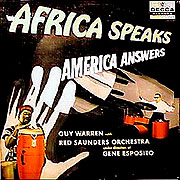
Side note no. 1: Guy Warren's first album, "Africa Speaks, America Answers" was recorded with the Chicago band he'd been playing with -- a band, which was, with the exception of Warren and an African-American drummer, composed entirely of Jews and Italians (who nonetheless did all right with the call and response stuff). Prof. Kelley also noted, as something of an aside, that although several influential African-American jazz musicians were drawn particularly to what they saw as the authentic African spirituality of Warren's music, Warren himself was neither Muslim nor Christian nor Animist but in fact a practicing Buddhist. Anyway, Kelley says his music was, perhaps not so surprisingly, ambitious and drew on a ton of different traditions: African, Jazz, classical, etc. This probably made him less than an ideal candidate for the role of "authentic African drummer".
Enter Babatunde Olatunji ... who came to the U.S. from Nigeria on a Rotary scholarship and attended Morehouse College and then NYU grad school, studying political science. To make extra money, he started playing music with an ensemble he'd put together — traditional West African stuff and original compositions, though Kelley notes that a lot of his training as a percussionist had apparently come from African American musicians he'd known since coming to the States.
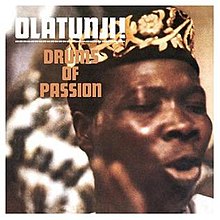
Anyway, Olatunji was playing at Radio City and got "discovered" by a Columbia record exec who signed him and, a year or two later, got him into CBS studios in New York to record "Drums of Passion" — which not only went on to vastly outsell anything by Guy Warren or, I think, any of the other Africanist projects by American jazz musicians, and in fact has never gone out of print, and now gets cited, on various promo-type sites, as being possibly first real (successful) "world music" album, the first real studio-recorded album of real African music, etc. etc. etc.
Whether or not Olatunji was better qualified than Guy Warren to be known as the introducer, at least he turned his popularity into a long and very legitimate career both in the African American, jazz, and world music communities. A few years before he died in the 1990s he did some sort of collaboration with one of the Grateful Dead, though which one I cannot say.
Fascinating story, I thought (and hopefully you think). So I hopped on over to iTunes to see just what the original authentic drummer sounded like. I clicked on the first track of "Drums of Passion" and ... well, something seemed awfully familiar.
Just what was going on here? Who copying who? A few searches turned up lyrics and the story of the song in question—
Akiwowo (Chant to the Trainman)
This is the song about the legendary conductor when railroud trains were first introduced in Nigeria over five decades ago. Millions still remember Akiwowo, who always made sure that his passengers, mostly men and woman returning from their farms with their products balanced on their heads,never missed the train, as well as his warm welcom, broad smile and humor. Akiwowo, now in his eighties,lives happily in the village of Pa-Pa Lanto full of sweet unforgettable memories of his service to his people and country.
Akiwowo Oloko lle lowo Gbe Mi Dele Ile Baba Mi
Akiwowo conductor of the train Please take me home To my fathers house
As for how exactly "Akiwowo" became "New York USA" let us turn to the following computranslation from Serge Gainsbourg's French record company:
Serge enters in studio from the 5 to October 16, 1964, with Goraguer, for a second 30 cm, "Gainsbourg Percussions". Via Guy Béart, it impregnates disc "Drums of Passion" of the Native of Niger Babatunde Olatunji.
For "New York the USA", Serge is inspired — rate/rhythm, arrangements, melody, technical question and answer between the singer and choruses — by "Akiwoko (Song To The Trainman)". For "Over there it is natural", of a counterpoint of Myriam Makeba.
Many years later, when to the USA a disc leaves Serge containing "New York the USA", Olatunji brought in Gainsbourg a lawsuit for plagiarism.
It seems worth noting that whereas "New York USA" was presumably adapted/recorded in France, "Akiwowo" was recorded (and quite likely written) in New York. So without too much difficulty we might imagine Olatunji listening to the clatter of subway or el trains and thinking wistfully back to the famed Nigerian railway conductor. (Incidentally, the click-click-clack percussion makes perfect sense with the original song's rail theme).
But of course we are left to ponder what exactly led Serge to impregnate disc "Drums of Passion", and why concerning New York, and for that matter what became of that lawsuit for plagiarism brought in him by the first original real and authentic African drummer in USA.
Postlude: More media! Here's a much-older Babamayo Olatunji performing a Liberian rhythm:
... and here's, from France's Institut National de l'Audiovisuel, a prehistoric music video of Serge Gainsbourg's "New York USA" — the song begins after a 1min. introduction by the French chanteuse Barbara:
... and — because I could —here's a map of all the buildings Gainsbourg sings about (scroll down for the Bank of Manhattan at the island's tip):
Victoria Falls/Mosi-oa-Tunya, Zambia/Zimbabwe, southern Africa
Nothing inspires, and inspires rivalry, like a good big thundering waterfall. A few months back, inspired by travelling friends, I began researching a catarract I knew about but had never visited, Iguazu Falls in South America. What I found was that when it comes to a giant waterfall, people want to know just how giant, and speciffically whether it's gianter than any other waterfall (which is a more difficult question than you might think, given the multi-dimensionality of waterfalls: height, width, flow at a given moment—imagine if Mt. Everest's prestige point for climbers was not that it's the tallest, but by some complicated, debatable formula the biggest. Oh the arguments we'd have!).
In the comparisons I found, Niagra Falls usually gets brought in the picture, especially in the older articles and guidebooks, but that's usually for the quick dismissal of a known quantity. The real showdown, of course, is invariably with Iguazu's African analogue, the probably-more-famous Victoria Falls. Depending on your point of view, Iguazu is "The Victoria Falls of South America"; and Victoria's the "African Iguazu".
(Back in my days editing travel guides such comparisons alternately amused and annoyed. Any city with canals becomes "The Venice of Wherever". The problem with such comparisons is that you're kind of implying the inferiority of the lesser-known part of the equation. "It ain't Venice, but it's the best we've got!")
And indeed, I was amused and annoyed at the waterfall-showdowns. But then I went looking for old maps and discovered something fascinating and (apparently) forgotten.
The Library of Congress's American Memory site proved, as ever, a great good treasure trove. (though difficult to link from ... I've moved some map images over to the blog; to find out more you can, of course, pop over search by the map name or keyword).
All right, first, let's get oriented with this 1998 CIA map. The Falls aren't labelled, but they're right next to the Triple Frontier between Brazil, Paraguay, and Argentina, where the Rio Iguazú flows due west into the Rio Paraná:
South America (1998)
Things were proceeding much as expected ... the falls were unlabeled, or marked with the name of the Brazilian border town, Foz do Iguaçu. But then I clicked onward to an 1873 map, from an atlas published by Charles Black and Co., Edinburgh, Scotland, and saw, where the Rio Iguazú flows into the mighty Paraná, an unfamiliar—or rather, too familiar—name:
Brazil, Uruguay, Paraguay & Guayana. (1873)
Instead of Salto del Iguazú, it was labelled Salto Victoria—literally, Victoria Falls! Was this some kind of Rule Britannia-style joke by the Scottish geographers? Some kind of continental clerical blunder? Or a cruel brief renaming of the falls in honor of Brazil and Argentina's then-recent evisceration of Paraguay during the War of the Triple Alliance?
Over the next few days I dug up more info on the surprising references to Iguazu Falls as Salto Victoria. I did find one other old map (Brazilian, 1908) with it labelled as Salto Victoria. All the others either just marked it as "salto" or didn't show anything beyond the intersection of the Iguazú and Paraná rivers.
Mappa geral da Republica dos Estados Unidos do Brasil (1908)
Paraguariæ Provinciæ soc. jesu cum adiacentibg. novissima descriptio ... (1732)
Having gotten through the maps, I started in on text searches—all but the first are from the ever-expanding 19th century universe that is Google Books. Thus, I guess, the 19th century all caps headlines. Anyway.
A BRIEF, LONG HISTORY — A VICTORIA BUT NO FALLS
Here's a story of the Falls' naming from an Argentinian tour operator:
A tourist venue par excellence, it was first glimpsed in the year 1542, when Alvar Núñez Cabeza de Vaca was crossing from the Atlantic Ocean to Asunción in Paraguay. The conquistador, amazed at the sight of the falls, christened them as "Saint Mary's Falls", a name which over time was replaced by its primitive Guaraní name: "Iguazu" (I: water; Guazú: great), i.e. "great waters". Iguazu. At that time the region was inhabited by natives of the Mbyá-Guaraní tribe, who, around 1609, began to live within the evangelizing influence of the Jesuit fathers, who set up an experiment unique to Latin America: the establishment of a system of "reductions", that at its height included 30 towns scattered throughout the regions of the Tapé and the Guayrá (currently the south of Brazil and Paraguay), all the Argentine province of Misiones, and part of the north of Corrientes.
Political and economic differences with the throne of Spain led to the expulsion of the Jesuits from the region in 1768. The zone of the waterfalls passed into oblivion from then on until August 1901, when the explorer Jordan Hummell organized the first tourist excursion to the area. One of those travelers was Victoria Aguirre, who, when this excursion had to turn back for lack of proper roads, donated a large sum of money to open a land-route between Puerto Iguazu and the waterfalls. This date marks the beginning of tourist trips to Iguazu, and has been claimed by the community as its foundation day, in homage to Victoria Aguirre, who then became a kind of protector, a driving force for the growth of tourism and of the population.
———
THE CONQUISTADOR CABEZA DE VACA DISCOVERS THE FALLS —BUT DOESN'T MENTION WHAT (IF ANYTHING) HE CALLED THEM
"The current of the Yguazú was so strong that the canoes were carried furiously down the river, for near this spot there is a considerable fall, and the noise made by the water leaping down some height rocks into a chasm may be heard a great distance off, and the spray rises two spears high and more above the fall. It was necessary, therefore, to take the canoes out of the water and carry them by hand past the cataract for half a league with great labor. Having left that bad passage behind, they launched their canoes and continued their voyage down to the confluence of this river with the Paraná."
Also, this French chronology mentions Cabeza de Vaca's discovery of the falls "later called victoria". And an 1892 New York Geographical Survey account mentions a "magnificent but little-known cataract called 'Salto Victoria' or the 'Hundred Cataracts'. These falls occur on the Iguazú River, a branch of the Paraná, about twenty miles from its mouth." After describing the trouble one must take to get upriver to view the falls, we get the usual extreme traveller's payoff:
The numerous tributary streams pouring over these cliffs, together with the principal cataracts form such a bewildering mass of falls, that one is utterly overwhelmed with the sublimity of the scene; and probably for combined beauty and grandeur of scenery, for wildness and variety of aspect, the "Hundred Cataracts" stand unsurpassed.
———
BUT NOW: PROOF THAT BRITISH AND BRAZILIAN REFERENCES TO THE SOUTH AMERICAN FALLS AS "VICTORIA" PREDATE LIVINGSTONE'S ARRIVAL AT THE AFRICAN FALLS
"The Rio Iguassú, or Curitiba, runs east and west for about 300 miles: it is navigable in the middle of its course, but before it reaches the Rio Paraná it forms a succession of water-falls, of which one, about 10 miles from its moth, is said to be 120 feet in perpendicular height; this fall is called Salto de Victoria. The country on both sides of the lower parts of its course is thickly clothed with high timber-trees."
"Victoria. Cachoeira do rio Iguaçu, 15 legoas pouco mais or menos, acima de sua confluencia com o rio Paraná. Entre a cachoeira Cayacanga d'este rio, e nas terras e matas adjacentes vivem diversas nações d'Indios que estão ainda por se civilizar."
"Victoria. Waterfall of the river Iguaçu, 15 leagues, more or less, above its confluence with the river Paraná. The Cayacanga waterfall of this river enters[?], and in adjacent lands and bushes diverse nations of Indians live that are still uncivilized."
Later in the same dictionary entry came this bit of comparison:
Nostros presenciábamos seguramente un espectáculo de primer órden, que sobrepasa a las decantadas maravillas de los Saltos de Niágara, Nyanja y otros, y estamos seguros que llamará la atencion de todo el mundo civilizado.
We are thus surely witness a spectacle of the first order, which surpasses the marvels of the Falls of Niagra, Nyanja, and others, and we are sure that they will seize the attention of all the civilized world.
I've had trouble figuring out whether Nyanja refers to the African Victoria Falls (that would make the most sense, given the comparison). Nyanja is one of the main languages of Zambia and the region around the Falls, and seems to be a more general term for lake, and one specificly applied to Lake Nyasa/Malawi, which is quite a bit further east. Livingstone records the pre-colonial name of Victoria Falls (and today the official title) Mosi-Oa-Tunya, which means "the smoke that thunders" in the Kololo/Lozi language. Other local languages give the falls names with that same meaning, e.g. Shingu wa mutitima (Bakota/Tokalaya) and aManza Thunqayo (Matabele).
———
AND NOW, SUMMING UP
What I found most surprising about this episode was not that there was a little-known former name for a famous geographical feature, but that it seemed to be so widely known 100 years ago, and yet no contemporary sources (at least web-searchable—that's a big caveat) seemed to mention the fascinating fact that the bigness debate between Victoria Falls and Iguazú Falls is, in fact, a case of even closer parallels. Surely there are historians of Latin America out there who know about Salto Victoria, Saint Mary's Falls, the Hundred Cataracts, and the Falls or Foz or Salto or Corrientes of the mighty Iguazú, Yguassu, Iguaçu.
At the end of the day, I think comparisons between waterfalls and cities with canals and so forth are fine and useful, as far as they go. I think having, and learning, multiple names for things is wonderful. The more the merrier. It's always fun trying to figure out the "original" name of some great site, but also to realize that quite often there's no one traceable original (just as, so often, there's no one traceable "discoverer", especially once you set the big-name explorers in their proper place).
I'm fascinated by on-the-fly language hybrids: Spanglish, Sheng (Kiswahili-English), the "HUGME" (Hindu-Urdu-Gujarati-Marathi-English) of Salman Rushdie's many-tongued Bombay. The other day I was emailing a friend about mixing French and Arabic in Tunisia, and hours later came across (via Language Log via Langauge Hat) some anecdotes on the real-world usefulness of Fusha (aka standard written Arabic) vs. French vs. local dialects.
This situation makes the task of foreign learners more difficult, since they need to learn to deal appropriately with a very broad range of mixtures of "high" and "low" languages. This is true to some extent in any language, but the range of diglossia in "Arabic" appears to be significantly greater than in most other modern situations. You need to imagine a situation in which "Latin" is used to refer not only to classical and patristic Latin, but also to the spoken versions French, Italian, Spanish and Portuguese (with none of them having any standard written form).
And the longer usage anecdotes, quoted in Language Log but from a World Bank-hosted pdf:
Hela is a sixth-grade primary school student living in Tunis. She spends her summers in Nabeul with her grandmother. Her two best friends there are Hiba and Meriem. Hiba lives in Nabeul all year round and is the same age as Hela. Meriem is a year older and lives in La Marsa during the school year. Hela goes to a private school where she started French and Arabic at the same time. She has more than 20 hours of classes in Arabic and about 10 hours in French a week. All the subjects other than French, such as Math and Biology, are taught in Fusha. Sometimes the teacher explains things in Arbi, but the students often have to speak in Fusha. Hela does not like Fusha as much as Arbi, it feels too alien to her. She even likes French better than Fusha. Meriem’s classes are a lot like Hela’s. She prefers French and often uses French words when she’s speaking Arbi. She thinks it makes her sound cool, like an adult. Hiba, on the other hand, didn’t start French until the third grade. Even though she now has the same number of hours of each language as Hela does, she prefers Arabic (both fusha and Arbi) to French and reads more Arabic books.
The three girls play together and watch television. Their favorite shows are Saoussen, which is in Fusha, and Les Schtroumfs, which is in French. Sometimes, when they play, they pretend to be the cartoon characters and try to sound like them. Hiba likes playing Saoussen best, because she doesn’t play well when they speak in French. Meriem prefers Les Schtroumfs because her Fusha is poor. They usually just speak Arbi together. After the summers over, Hela and Meriem go back to their homes. They decide to write each other letters over the school year. After the first day of school, Hela runs home to write letters to her friends. She starts to write a letter to Hiba, in Fusha, but feels that this is not a friendly letter. It feels more like homework. She thinks in Arbi, but cannot write what she means, and has to translate. Frustrated, she decides to write to Meriem first. She quickly realizes that her best bet is to write in French, but still struggles with finding the right words to say what she means. Finally, she settles on using Arbi words that she approximates phonetically and finishes one letter. For Hibas letter, though, its harder for her to do this with Fusha, so she just writes a very short letter and writes some words in French. These solutions work, but leave her feeling unsatisfied. She feels closer to Meriem because she can communicate with her better. She rapidly loses interest in writing to Hiba, though.
Hela's cousin, Farah, grew up in Saudi Arabia. She is the same age as Hela and is in the fourth grade. Farah only speaks Saudi Arabic, Fusha, and English, which she studies at school. She feels that Fusha is strange and silly. Nobody really speaks it there either. When Farah and Hela get together, they can only speak a mixture of their dialect with Fusha. It is very strange for both of them. They hardly ever write each other letters, because they’d have to do it in Fusha, which neither feels comfortable with. Farah feels resentment towards Fusha and reads even less. She doesn’t like music in Arabic as much as English or French music and only reads in Arabic if it is mandatory. Her French continues to improve and her Fusha remains poor. This does not bother her though, because she knows that once she gets to secondary school, Fusha would be much less important and if she wants to be a doctor when she grows up, she will only need French.
After the death of her husband, Lilia's life revolves solely around her teenage daughter, Salma. Whilst looking for Salma late one night, Lilia stumbles upon a belly dance cabaret and though initially reserved and taken aback by the culture of the place, Lilia gets consistently drawn back to it. She befriends one of the belly dancers and is encouraged into dancing for the audience. Lilia also starts a romance with one of the cabaret's musicians, who unbeknown to both of them, is also romancing Salma.
I haven't seen Dirty Dancing so I can't tell whether Satin Rouge covers all the bases. It's definitely more risque/rebellious than, say, Strictly Ballroom. And the mother-daughter romance twist, especially at the end, felt a little like a French version of Monsoon Wedding: beautiful, witty, but more than a little creepy.
From director Raja Amari's bio info, I glean that she studied belly dancing at Tunis's top conservatory, but had never witnessed it in the cabaret context till she started work on Satin Rouge. So the forbidden aspect was not the type of dance, but the venue, which I found interesting.
I'll also note that it's the sole Tunisian film that my library system has, excluding stuff like Patton or Humphrey Bogart's 1943 vehicle (literally—it's a tank!) Sahara.