I'm fascinated by this bank ad that ran on the front page of DNA India: First, the suggestion that comfy retirement offers the chance to finally play the violin—a worthy goal, though I wonder how often arthritis might get in the way. But what really struck me was the non-Stradivarius-copy features of the fiddle: the slightly larger f-holes, and, above all, the fact that there's only one string! Was this just an error on the part of the props department, or a subcontinental adaption? A few quick searches turned up references to a one-stringed Indian viol called a riti, so perhaps it's that. Though I think in India classical music, the violin tends to be held in a pretty different posture. So who knows? Maybe you!
In any case, I was reminded of the 19th-century Italian virtuoso Niccolò Paganini:
In performance Paganini enjoyed playing tricks, like tuning one of his strings a semitone high, or playing the majority of a piece on one string after breaking the other three.
This was the main image on last Friday's Mississippi Clarion-Ledger. Usually I feel a little bad making fun of design choices on not-so-major newspapers—presumably everyone's doing the best with the resources and talent they have on hand. But this Photoshop siamese-twin montage is realy too much. Though including the deposed police chief's microphone as a sort of cancerous growth sticking out from the Mayor's neck does add a bit of metaphoric interest.
Surveying a handful of American newspapers last Sunday, I had fun doing a close comparative reading of how they handled the end of daylight saving time. I guess it's a sad-but-true fact of the mechanics of newspaper journalism that perhaps the most crucial (in terms of having direct effects on the immediate lives of their readers) information that will grace the front page all year is a little graphic of a clock with its hour hand in a motion-blur, springing foreward or falling back.
LA Times: Fall Back Did you remember to change your clocks? Daylight saving time ended at 2 a.m. Atlanta Journal-Constitution: Time has changed Did you remember to set your clocks back at 2 a.m. today, or when you went to bed last night? Hope so.
Boston Globe: Turn clocks back Daylight saving time ended at 2 a.m. today. Set your clocks back one hour.
Jackson (MS) Clarion-Ledger: Fall back Did you remember to set your clock back one hour and change batteries in smoke detectors?
New York Times: A Reminder Standard time resumed at 2 a.m. today. Clocks were set back one hour.
I love the nuances of tone and paper-reader relationship implied in the slightly different phrases. Is the paper offering a patient, reminding, question-marked question; sneaking in an added public-safety tip (darn it! we will be usefuller than the competition!); offering a stern no-fuss order (Boston); or, befitting the paper of record, recording the event for posterity, with none of that messy directly-addressing-the-reader stuff. "Clocks were set back": Pure objective passivity, or so they want us to think.
From the American Foundation for the Blind's Helen Killer Kids Museum website: Here's the description, descriptive indeed for the sight-impared user, and a bonus for the rest of us:
This faded photograph, from 1902, shows four people on a sunny front porch. Helen is seated on the far left, smiling, while Anne stands behind her, signing into her hand. To their right is Mark Twain, sitting with his hands folded in his lap, and Laurence Hutton, who is standing behind Twain and holding a cigar. Hutton was Literary Editor of Harper's magazine and a supporter of Helen's education.
And here is Thomas Edison's 1909 film of Mark Twain—I think the only one there is—of the author doing a silly walk and playing cards with his daughters:
The recollection that sent me off gleefully discovering the above, was a quotation in an article of a few years back, perhaps the New York Review of Books, in which Keller described in detail the timbre of Twain's voice, felt by touching his throat as he talked. I couldn't track the article, or the original down, but this will do well in its place:
The Story of My Life, chapter XXIII:
I read from Mark Twain's lips one or two of his good stories. He has his own way of thinking, saying and doing everything. I feel the twinkle of his eye in his handshake. Even while he utters his cynical wisdom in an indescribably droll voice, he makes you feel that his heart is a tender Iliad of human sympathy.
I find it thrilling how, 97 years after Twain's death, probably the best, the closest description we have of his voice was from someone who couldn't, in the usual sense, hear—but whose gift, to herself and to the world, was in learning, largely through metaphorical skill, to transcend the gaps and silences that separated her from his world, and him from ours. "I could feel the twinkle of his eye in his handshake". Wonderful.
I'll break the celebrity-gossip silence of this blog with the following article, from the Mumbai daily DNA India:
HYDERABAD: It would have been the ideal film script except that nobody is in a mood to oblige. Last week’s elopement by Telugu megastar Chiranjeevi’s daughter Srija has set the film industry and the elite of Hyderabad on alert to the likely dangers from their rebellious offspring. The star, though, said that all was forgiven and extended his blessings to the young couple.
Despite the olive branch from dad, the next day the same paper reported that Srija was seeking police protection from Delhi for her husband, who was still threatened by angry family members. It's easy to focus on the silly side, but I should note that the sense of threat (and, for the "aggrieved" family, shame/dishonor) presumably make a lot more sense in a non-Western, less-individualistic cultural context (though the role of Indian film stars in adapting Western-style stardom adds some shades of irony). In any case—and back to silly—if Chiranjeevi's film roles are any indicator, he's not someone you want on your bad side:
The DNA article continues:
Film producers, directors and financiers in the city have tightened security arrangements and cut short holiday trips of their children. They have now sent them to closely guarded resorts and bungalows around the city where their contact with “friends” and associates is restricted. The city police have also been considering a special cell to keep a tab on children of VIPS and VVIPS as a matter of routine exercise. ... Hyderabad is home to nearly 1,275 powerful families of industrialists, politicians and settlers from West Bengal, UP and Delhi. There are 27 private security agencies of which seven specialise in personal security for children of the rich and famous.
It took me a second or two to figure out what VVIPs meant (think Very, Very). I guess in a country the size of India you need the distinction. I wonder what the cutoff is to garner the extra V? Also I love the humble specificity of "nearly 1,275".
All this brought to mind—and this will be no comfort for the concerned powerful families in Hyderabad—this catchy song, by the androgynous (and on multiple other counts bizarre) French pop artist Katerine:
I've been enjoying some of the super-long 1960s New Yorker article-cum-books that are hidden in the DVD set I got last year for Christmas—this week it's Truman Capote; before that it was Hannah Arendt. The tradeoff for having to read 'em on the computer screen is that the lovely timeless prose is interleaved with the very ephimeral ads of the day—it's amazing how differently they wrote and paced ad copy and chose suitable illustrations back in the day. So I was reading "Eichmann in Jerusalem" and learning about the banality of evil and the banality of Bergdorf-Goodman's clothing sketches, when I came to the following full-pager (The New Yorker, May 16, 1963, p. 87):
That headline reads: "New Inner Circle is for women with delicate skin". Here's the ad copy:
I remember the 1980s and 90s anti-vivisection campaigns directed at cosmetics companies testing on rabbits* — unearthing yet another ugly secret from the beauty industry, with the clutch photo being of a lab rabbit with harspray in its rheumy taped-open eyes. What's amazing about this ad (aside from its ironic placement in of a history of individuals designing and perpetrating exceedingly evil acts against other people, many under the impression that they were doing something for the greater "good")** is that the cosmetics bunny isn't the secret, she's the salesman. This is definitely of the pre-Vietnam, all-trusting era: "you know we'd never hurt this bunny with our products, ergo our product will never hurt you".
* How much was it the cuteness that made it seem so awful? I don't know that rabbits are more deserving of protection or outrage-on-behalf than rats or mice.
** I actually think this irony may be less than it seems. There's an unfortunate temptation to equate cruelty/misuse of people with that of animals. I think they're both awful, but are by no means the same — and indeed a blurring of the human/animal distinction has historically, I think, tended to make it easier to be cruel people more than it's made it harder to be cruel to animals. Great minds and men may disagree (didn't Gandhi say something about it?) but that's my hunch.
I'd remembered Gandhi's last words, after he was shot by his asassin, were "He Ram!", which was translated, perhaps a little too universal-ifyingly, as "Oh God!" Though it may be that's what Gandhi would have intended.
Anyway, so it was the alternate transliteration of he that got my attention in this headline, from the Mumbai newspaper DNA:
The article raises a lot of issues from India's recent past, particularly the place, literally and figuratively, of the god Ram, and stories associated with him, in Hindu (and Indian) identities. In the 1990s the flashpoint was a mosque torn down in Ayodhya because it stood on a site associated by some with Ram (his birthplace? I forget). Now it's to do with plans to dredge a canal through Adam's Bridge, the shallow archipelago that links India and Sri Lanka, which has traditionally been linked with the bridge built by the monkey-god Hanuman in the the Ramayana. An atheist minister in Tamil Nadu made some comments about it being silly to think of the bridge as an architectural site worthy of protection (as some from the anti-canal camp were arguing), and then the argument got to be over whether said minister ought to have made those comments, whether it was an insult to Indian-ness/Hindu-ness.
Anyway, so Ram-awareness is on the upswing among Hindu nationalists, even to the point of coopting Gandhi's favorite Ram-hymn (despite the fact that the mahatma himself was quite at odds with the anticedants of today's Hindu nationalists—or at least the extreme ones. And they (witness the asassination) with him.
Serious and complex matters. But, a little pathetically, the main thing the headline made me think of was The Beatles' song "Hey, Jude". I'll hold off on deciding whether that song could, with the simple name substitution, be used to illustrate an episode or two from the Ramayana (and whether or not that'd be a good thing).
Laugh not, it's been done before: witness animator Nina Paley's mesmurizing, inspiring, and vaguely troubling Betty-Boop-meets-Busby-Berkley-meets-the-Delhi-Durbar series, The Sitayana, in which episodes from the Ramayana are given a feminist slant and set to the alluring melancholy music of 1920s jazz vocalist Annette Hanshaw:
If you liked that segment, head to the The Sitayana site proper, which has segments from several episodes/songs, in a slightly better quality form.
Here's an ad that sometimes runs the full bottom span of the Sydney Morning Herald. I just thought it was odd to use a raccoon as a spokes-animal, especially given Australia's many zany indigenous species. Does a raccoon scream "North America" like a kangaroo screams "Australia" hereabouts?
A brief South Indian typography lesson from John Murdoch, Classified Catalogue of Tamil Printed Books (Oxford: 1865). In some ways I think I prefer the "BAD" to the "MEDIUM"—the former's blotchy, but the spacing is more even.
Last fall I set myself the goal to draw a quick sketch of a person from each and every of the 244 Wikipedia-sanctioned countries in the world, in alphabetical order and alternating between men, women, boys, and girls (hence the name of the project). I started with "Abkhazia Man" in October, 2006 and finished "Zimbabwe Girl" in August, 2007. The source images were found using flickr or Google searches. All the photos were drawn with a Bic ballpoint pen in a nice black notebook I had left over from my dot-com days. Here's an embedded flickr slideshow:
The next order of business, of course, will be to figure out how to present these images in map form.
Till then, some notes on the project: throughout, I was aware of the problematic notion of selecting a de facto "representative" portrait for every country—and the equally-problematic notion of pretending that I wasn't. This problem is obvious for widely multiracial countries like the USA or Malaysia (who gets to be "the" American face?), but perhaps more insidious for presumably "less-diverse" countries like Sweden or Zambia, where choices between "traditional" or "modern" faces might bear their cultural baggage more subtly. So part of my way-out was to leave it up to the search results, picking the first striking and sketchable-by-me face that came up in the returns. But even the fact that I simply tried to dismiss people who seemed to be obvious tourists in favor of those who looked to me like locals, undermines that algorithm.
Well, whatever. My goal for the project was to give myself the chance to explore and rejoice in the variety of the world's faces, and I think I achieved at least a bit of that in my compilation. As for the artwork itself: it is nearly universally safe to assume that my sketches don't do the source images, let alone the people behind them, justice. Usually I was pleased if my portraits looked like a plausible person, if not the one I was trying to draw.
In general I think the younger women and girls bore the worst of my artistic lapses: an ill-plotted jawline on a guy could usually be turned into a five-o'clock shadow, but finer features proved less forgiving of my misdrawn lines. And I don't think I came near depicting the wonderful variety of my subjects' skin tones (dulled though they were by photography). Often as not, folks I was trying to draw darker just got scruffier.
The project has certainly been much more of an exercise than a finished artwork—hence the occasional experiments with widely varying techniques of line and shade. I'd hoped, from A to Z, that I'd get better and better at drawing ballpoint portraits. In the end, though, I think I mainly got faster.
This week I watched a very interesting French documentary Le fantôme d'Henri Langlois about the manic-obsessive-brilliant-wonderful film preservationist who founded the Cinémathéque Française. Along the way, he mentioned the two contrasting foundational figures of French cinema, the Lumière Brothers, and George Méliès. Here's a sample of the former:
The Lumière clips they included were definitely fascinating—how could documentary footage of people walking around in 1895 not be fascinating? but the Meiloc ones really piqued my interest (as they did Langlois'—he used to pull out the old, flammable prints to show them as a special treat to the Cinematique's imployees). I'd heard him mentioned in Michael Silverblatt's interview with Brian Selznik, whose illustrated novel The Invention of Hugo Cabret is full of magical Méliès referencces and tips-of-the-hat. The thing that stuck with me there was the comment that, although Méliès discovered and pioneered all of these amazing and surreal special effects, he never discovered (or at least used) that most basic of effects: moving the camera. All of his shots are framed more or less like a theater stage—or, better said, the stage in a magic show.
Here are two Meiloc films from YouTube, L'homme a la tête en caoutchoc ("The man with the rubber head", 1901) which is a more basic magic-show setup, and the delightfully surreal (and famous-in-places) Le voyage dans la lune ("A Trip to the Moon", 1902), which crams near-infinite motion into that non-moving camera.
A few of my friends are in Lebanon for pre-wedding festivities this week; in honor of that I found this 1799 travel narrative (Travels in Africa, Egypt, and Syria, from the Year 1792 to 1798 by William George Browne) which has that distinct eighteenth-century advantage, namely that the lower-case s's are typeset almost the same as f's, giving the whole thing a very funny lisping look, and not a few fun outright misreadings (like that key Syrian export, filk).
Google Books now allows for easy posting of old, good book snippets. This removes about eight steps from my process. Let's celebrate with a (presumably hand-colored) plate from an Oxford library copy of Foreign Butterflies by James Duncan (London: 1858): "
Prelude: Nine years ago when I was editing travel guides, it was a matter of pride for the musically-inclined editors to blast the office with guidebook-appropriate (or hilariously-innappropriate) music. For me, of course, that was arranged with a perpetual connection to a Bollywood-themed internet radio station. Over in the "domestic" room, the editors played Frank Zappa, Jonathan Richman, and, when a great laugh was needed, the following song, by French pop master Serge Gainsbourg:
[N.B. This embed, and for that matter the others, doesn't seem to work ... you can get the same effect by going to www.deezer.com and searching for "Serge New York". I'll work on the odeo players soon, I hope]
OK, forget all that for now. What I really want to write about is a story I heard whilst listening to one of the many excellent W.E.B. Du Bois Institute lectures they got online somewheres, specifically a series by (then) NYU prof Robin D.G. Kelley on Jazz and Modern Africa:
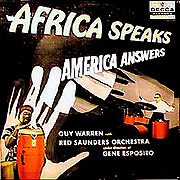
In this particular lecture he was talking about the specific mid-twentieth-century debate over who was and wasn't an "authentic" African drummer during the early cross pollinations between American jazz and music from contemporary Africa (the music itself, of course, having elements traditional and contemporary). Kelley's lecture is a lot about Guy Warren, who came from Ghana to the states in the early(?) 1950s with the goal of introducing the talking drum to American jazz. His first records wound up coming out around the same time, more or less, that a few African-American jazz drummers (Art Blakey, and later I think Max Roach) were starting to use explicitly African titles and themes in their records. Basically Warren thought Blakey et al's music wasn't African at all, and was for that matter completely uninteresting.
Side note no. 1: Guy Warren's first album, "Africa Speaks, America Answers" was recorded with the Chicago band he'd been playing with -- a band, which was, with the exception of Warren and an African-American drummer, composed entirely of Jews and Italians (who nonetheless did all right with the call and response stuff). Prof. Kelley also noted, as something of an aside, that although several influential African-American jazz musicians were drawn particularly to what they saw as the authentic African spirituality of Warren's music, Warren himself was neither Muslim nor Christian nor Animist but in fact a practicing Buddhist. Anyway, Kelley says his music was, perhaps not so surprisingly, ambitious and drew on a ton of different traditions: African, Jazz, classical, etc. This probably made him less than an ideal candidate for the role of "authentic African drummer".
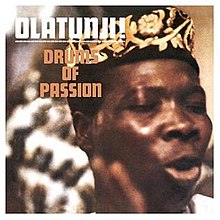
Enter Babatunde Olatunji ... who came to the U.S. from Nigeria on a Rotary scholarship and attended Morehouse College and then NYU grad school, studying political science. To make extra money, he started playing music with an ensemble he'd put together — traditional West African stuff and original compositions, though Kelley notes that a lot of his training as a percussionist had apparently come from African American musicians he'd known since coming to the States.
Anyway, Olatunji was playing at Radio City and got "discovered" by a Columbia record exec who signed him and, a year or two later, got him into CBS studios in New York to record "Drums of Passion" — which not only went on to vastly outsell anything by Guy Warren or, I think, any of the other Africanist projects by American jazz musicians, and in fact has never gone out of print, and now gets cited, on various promo-type sites, as being possibly first real (successful) "world music" album, the first real studio-recorded album of real African music, etc. etc. etc.
Whether or not Olatunji was better qualified than Guy Warren to be known as the introducer, at least he turned his popularity into a long and very legitimate career both in the African American, jazz, and world music communities. A few years before he died in the 1990s he did some sort of collaboration with one of the Grateful Dead, though which one I cannot say.
Fascinating story, I thought (and hopefully you think). So I hopped on over to iTunes to see just what the original authentic drummer sounded like. I clicked on the first track of "Drums of Passion" and ... well, something seemed awfully familiar.
Just what was going on here? Who copying who? A few searches turned up lyrics and the story of the song in question—
Akiwowo (Chant to the Trainman)
This is the song about the legendary conductor when railroud trains were first introduced in Nigeria over five decades ago. Millions still remember Akiwowo, who always made sure that his passengers, mostly men and woman returning from their farms with their products balanced on their heads,never missed the train, as well as his warm welcom, broad smile and humor. Akiwowo, now in his eighties,lives happily in the village of Pa-Pa Lanto full of sweet unforgettable memories of his service to his people and country.
Akiwowo Oloko lle lowo Gbe Mi Dele Ile Baba Mi
Akiwowo conductor of the train Please take me home To my fathers house
As for how exactly "Akiwowo" became "New York USA" let us turn to the following computranslation from Serge Gainsbourg's French record company:
Serge enters in studio from the 5 to October 16, 1964, with Goraguer, for a second 30 cm, "Gainsbourg Percussions". Via Guy Béart, it impregnates disc "Drums of Passion" of the Native of Niger Babatunde Olatunji.
For "New York the USA", Serge is inspired — rate/rhythm, arrangements, melody, technical question and answer between the singer and choruses — by "Akiwoko (Song To The Trainman)". For "Over there it is natural", of a counterpoint of Myriam Makeba.
Many years later, when to the USA a disc leaves Serge containing "New York the USA", Olatunji brought in Gainsbourg a lawsuit for plagiarism.
It seems worth noting that whereas "New York USA" was presumably adapted/recorded in France, "Akiwowo" was recorded (and quite likely written) in New York. So without too much difficulty we might imagine Olatunji listening to the clatter of subway or el trains and thinking wistfully back to the famed Nigerian railway conductor. (Incidentally, the click-click-clack percussion makes perfect sense with the original song's rail theme).
But of course we are left to ponder what exactly led Serge to impregnate disc "Drums of Passion", and why concerning New York, and for that matter what became of that lawsuit for plagiarism brought in him by the first original real and authentic African drummer in USA.
Postlude: More media! Here's a much-older Babamayo Olatunji performing a Liberian rhythm:
... and here's, from France's Institut National de l'Audiovisuel, a prehistoric music video of Serge Gainsbourg's "New York USA" — the song begins after a 1min. introduction by the French chanteuse Barbara:
... and — because I could —here's a map of all the buildings Gainsbourg sings about (scroll down for the Bank of Manhattan at the island's tip):
A couple of weeks back I was watching a Chinese film, Quitting (Zuotian - 昨天 - trailer here), a really great semi-documentary about a young actor coming out of drug addection in 1990s Beijing. There's one scene where all the young cool folks are hanging out together, celebrating the protagonist's birthday, and they start singing a song to the tune of the old American gold-miner's lament, "Oh My Darling, Clementine".
I rewound the movie so I could type out the subtitles:
wish you longevity as long as a pine tree of the Southern Mountain may you have good fortune as much as the endless water in the Eastern Ocean
I emailed a bunch of Chinese-American friends to find out if they knew anything about this version of "Clementine" —and whether it was a specific "birthday song" used, perhaps, in place of the ubiquitous, but technically still copyright-protected "Happy Birthday To You"? But nobody'd heard aything about it.
Interestingly—getting back to copyright—The Beatles' music plays a significant role in the plot of Quitting, but makes no appearence on the soundtrack—it's all Chinese rock (which works quite well—even in the scenes where you're watching the main charactar listening to a Beatles album on his headphones ... actually, the whole film is accessible but also again and again visually, sonically, and conceptually arresting).
In any case, I wonder when the "Clementine" melody made it back to China ... obviously Chinese immigrants were an important of Gold Rush (and post-Gold Rush) California ... perhaps it made it back soon after it was written (in the 1880s, but based, perhaps on a song from the 1860s). Most likely it arrived much more recently. But I like the idea of a former Chinese "Miner '49er" making his way back to China in his old age (long as the pine on the Southern Mountain), bringing the song from Gold Mountain.
Though I've already posted on M.I.A., her second album, Kala, is out this week, complete with a wonderful Mobutu-print-inspired cover. She did a lovely live session at KCRW a couple weeks back — I was beside myself when she launched the first song, "Bamboo Banger" with a half-cover of Jonathan Richman's "Roadrunner" (though omitting the part about driving to the Stop-N-Shop). I also loved a line from her second song, "Hussel", that went more or less, "I put people on the map / who've never seen a map". And I can't tell whether her off-pitch singing is a sort of casual swagger or an homage to the semitonal wonders of South Asian (and particularly South South Asian) singing styles. Probably both.
Rounding out music news: Josh Ritter has a new album, e'en edgier than the last but sounding quite good from what I've heard. I'll have to get it sometime.
And two recent indie-rock discoveries: Vampire Weekend (think Paul Simon's Graceland with a punk-pop sensibility), and Bishop Allen (I heard their song "Castanets" on the KEXP podcast and thought, "wow, what a great song!"; then looked up the band name and thought, "wow, they're named after one of my favorite-named Cambridge, MA streets!", then looked at who was in it and thought, "wow, I used to work in the same office as the lead singer! we used to nod hello!").
In one of Walker Percy's novels (Lancelot, I'm pretty sure), the narrator mentions a 19th century duel that was fought on an island in the Mississippi river so as to be outside the jurisdiction of any state. The theme resurfaces later on in one of the meant-to-provoke questions in Percy's Lost in the Cosmos: Why didn't anyone ever write a novel about rafting down the Hudson River? The answer, if any, has to do with the statelessness of a border-river: you're neither in one place or the other, passing by without necessarily entering.
Of course, no islands in the Mississippi are truly without jurisdiction—there's always a dotted line on some map. But the current dotted line's often quite fascinating. Below's a particularly jigsawed stretch south of Vicksburg. Some of the jogs are reminders that rivers change course from time to time (hence too the beautiful-from-above filigree of oxbow lakes). But I'm not sure the dotted line always follows a former river-course either.
A few weeks ago my father surprised me with a garage-sale gift: an old Oscar Schmidt Autoharp. Since then I've sporadically been figuring out how to play it ... the basics of which are more involved than I'd supposed. First, there's the matter of deciding how you want to hold and strum it. Here are some examples, with my own made-up titles for 'em:
A) The Mirror. I discovered this video during a fruitless attempt to find a recording of Jimmy Carter reading some of his poetry. The consolation prize, as you'll doubless agree, was more than worth it. Note the left-handed strumming, which is easiest given a tabletop-layout, but feels just wrong since I already play cello and guitar in the standard poses.
B) The Bridge-Strummer. Difficult on my particular harp, which has the maximum amount of buttons/keys, narrowing the target era quite a bit. Still, can't argue with June Carter Cash:
C) The Crossover. Just plain awkward:
D) The Upright Reverse Half-Piano Hug. This is the one I've settled on. Earl Scruggs and Mother Maybelle Cash.
 First, the suggestion that comfy retirement offers the chance to finally play the violin—a worthy goal, though I wonder how often arthritis might get in the way. But what really struck me was the non-Stradivarius-copy features of the fiddle: the slightly larger f-holes, and, above all, the fact that there's only one string! Was this just an error on the part of the props department, or a subcontinental adaption? A few quick searches turned up references to a one-stringed Indian viol called a riti, so perhaps it's that. Though I think in India classical music, the violin tends to be held in a pretty different posture. So who knows? Maybe you!